A service level agreement is the part of a contract that says how well a supplier must perform, how that performance is measured, and what happens when targets are missed. Most guides to the service level agreement (SLA) are written for cloud uptime. Procurement teams also need an SLA for consultants, contractors and project-based suppliers, where the right measures are not server availability but how fast qualified profiles arrive, whether deliverables are accepted, and how quickly a departing consultant is replaced. This guide gives the definition, the metrics that fit services, three worked examples, a service credit formula and the controls that make an SLA enforceable.
What is a service level agreement (SLA)?
A service level agreement (SLA) is a contract, or a schedule to one, that sets the measurable service levels a supplier commits to, how they are measured, and the remedies that apply when targets are missed. It gives buyer and supplier a shared definition of good performance.
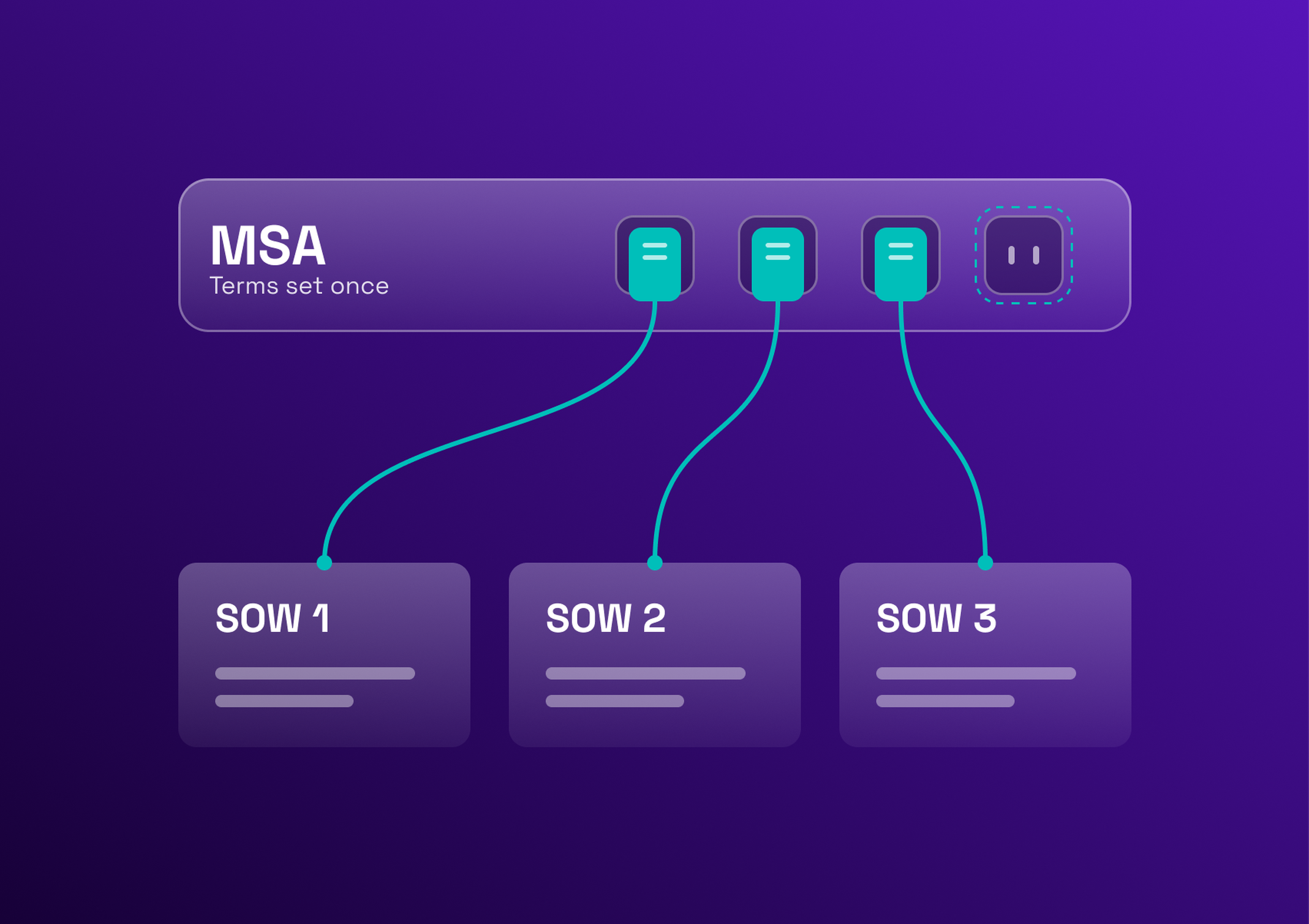
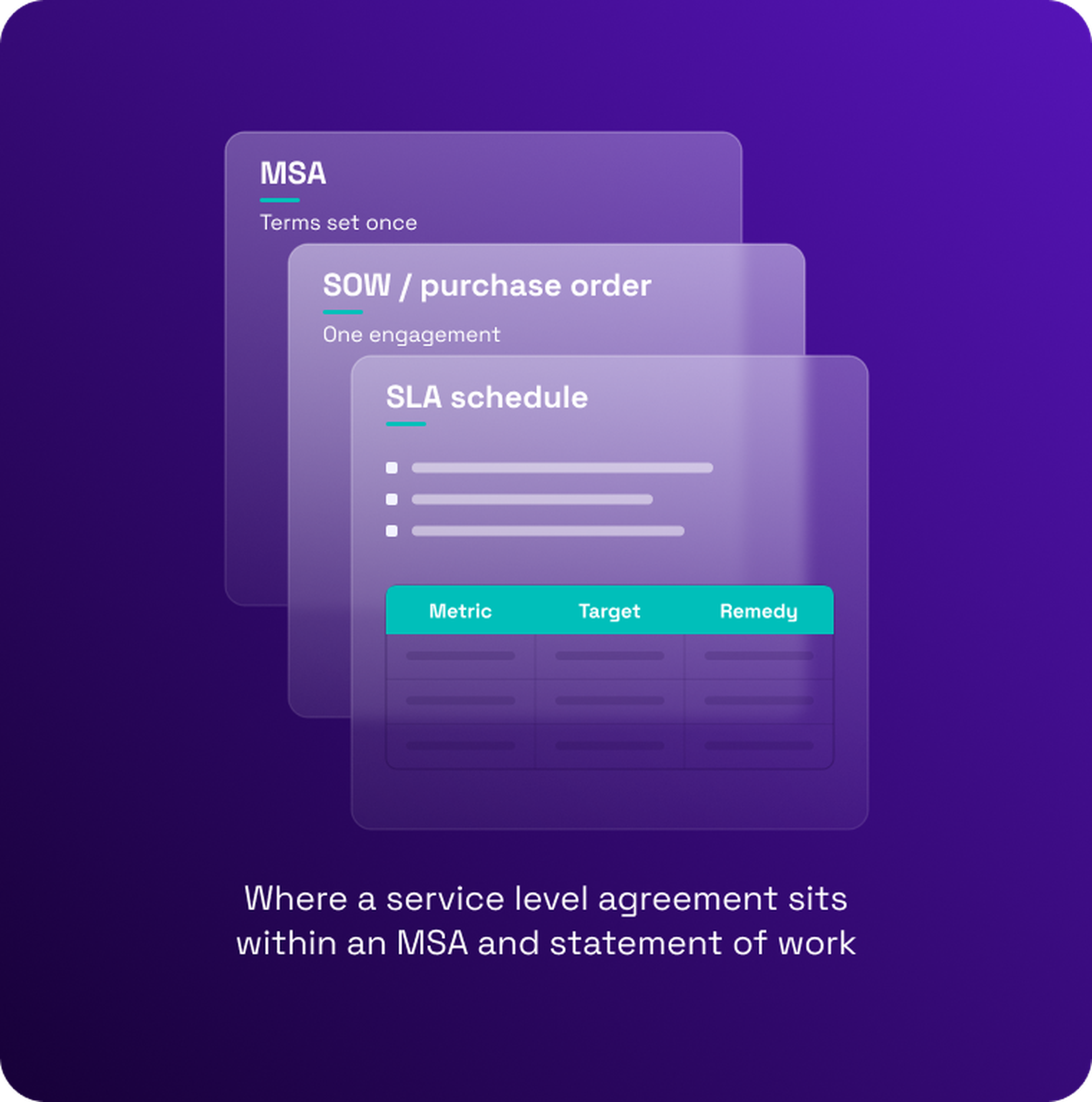
An SLA rarely stands alone. It is usually a schedule to a master services agreement (MSA), which sets the general terms, and it applies to the work ordered under a statement of work (SOW) or a purchase order. The guide to SOW-based procurement explains how that work is defined and run.
SLA vs KPI vs SLO vs SOW vs MSA: what's the difference?
A service level agreement vs KPI comparison is the most common source of confusion, and SLO, SOW and MSA add to it. The table separates the five.
| Term | What it is | Who owns it | Contractually binding? |
|---|---|---|---|
SLA | A commitment to service levels, with a measurement method and remedies | Procurement and the business, agreed with the supplier | Yes, when part of or referenced by the contract |
SLO (service level objective) | An internal target for a service level, often stricter than the SLA target | The supplier, or the buyer's operations team | No, it is a goal that supports the SLA |
KPI (key performance indicator) | A metric that shows how well something performs | The team that manages the supplier | No, it informs decisions |
SOW | The description of one engagement: scope, deliverables, schedule and price | The business manager, with procurement | Yes, once signed |
MSA | The general terms that govern all engagements with a supplier | Procurement and legal | Yes |
A KPI tells you how a supplier is doing. An SLA tells you what they have committed to and what happens if they miss it. The guide to supplier performance KPIs covers the indicators in depth.
The 3 types of service level agreements
SLAs come in three types, and these service level agreement levels differ in how many customers and services they cover.
Customer-based SLA. One agreement covers everything a customer buys from one supplier. Example: a bespoke SLA with a strategic engineering partner that covers all its engagements.
Service-based SLA. One agreement covers one service, with the same terms for every customer. Example: one SLA for all IT consulting suppliers, so that every supplier of that service is held to the same targets.
Multi-level SLA. Several layers apply together: corporate terms for every supplier, customer terms for one supplier, and service terms for one type of engagement. An SLA of this kind suits large panels.
Inside the company, an operational level agreement (OLA) does the same job between procurement and business units, for example on how fast a request is approved.
Why SLAs matter when you buy consulting, IT and engineering services
A procurement service level agreement does five jobs when the work is done by people rather than servers. The same logic applies to a SLA for outsourcing a whole function.
It aligns business teams and suppliers on what "good" looks like. It turns expectations into numbers both sides can check.
It protects budgets on fixed-price work, because delay and rework have a price.
It makes suppliers comparable. Two suppliers measured on the same metrics can be ranked.
It gives grounds for renewal or exit decisions that are based on data, not on impressions.
It supports contractor compliance, because documents and checks can be written in as commitments. See the guide to contractor compliance requirements.
Key components of a service level agreement
A reference point for IT service management is ISO/IEC 20000-1:2018, the international standard for service management systems, which includes service level management among its processes. For services bought from external suppliers, ten SLA components cover most agreements.
Parties, scope and duration. Who is bound, which services are covered, and for how long.
Service description and deliverables. What the supplier provides, in terms that can be checked.
Acceptance criteria. For fixed-price and SOW work, what a deliverable must satisfy to be accepted.
Key personnel and replacement commitments. Who is named, and how fast a departing consultant is replaced.
Service levels and targets. The metrics and the value expected for each. Set them before award, as the guide to how to write an RFP for services recommends.
Measurement method and data source. Who measures, in which system, and what counts as a miss.
Reporting frequency. How often results are shared, and in what format.
Remedies. Service credits, penalties, bonuses and earn-backs.
Escalation path and governance meetings. Who is called, in what order, and when the issue goes up a level.
Review, change and termination clauses. When the SLA is reviewed, how it is amended, and when repeated misses allow exit.
SLA metrics for consulting, IT and engineering services
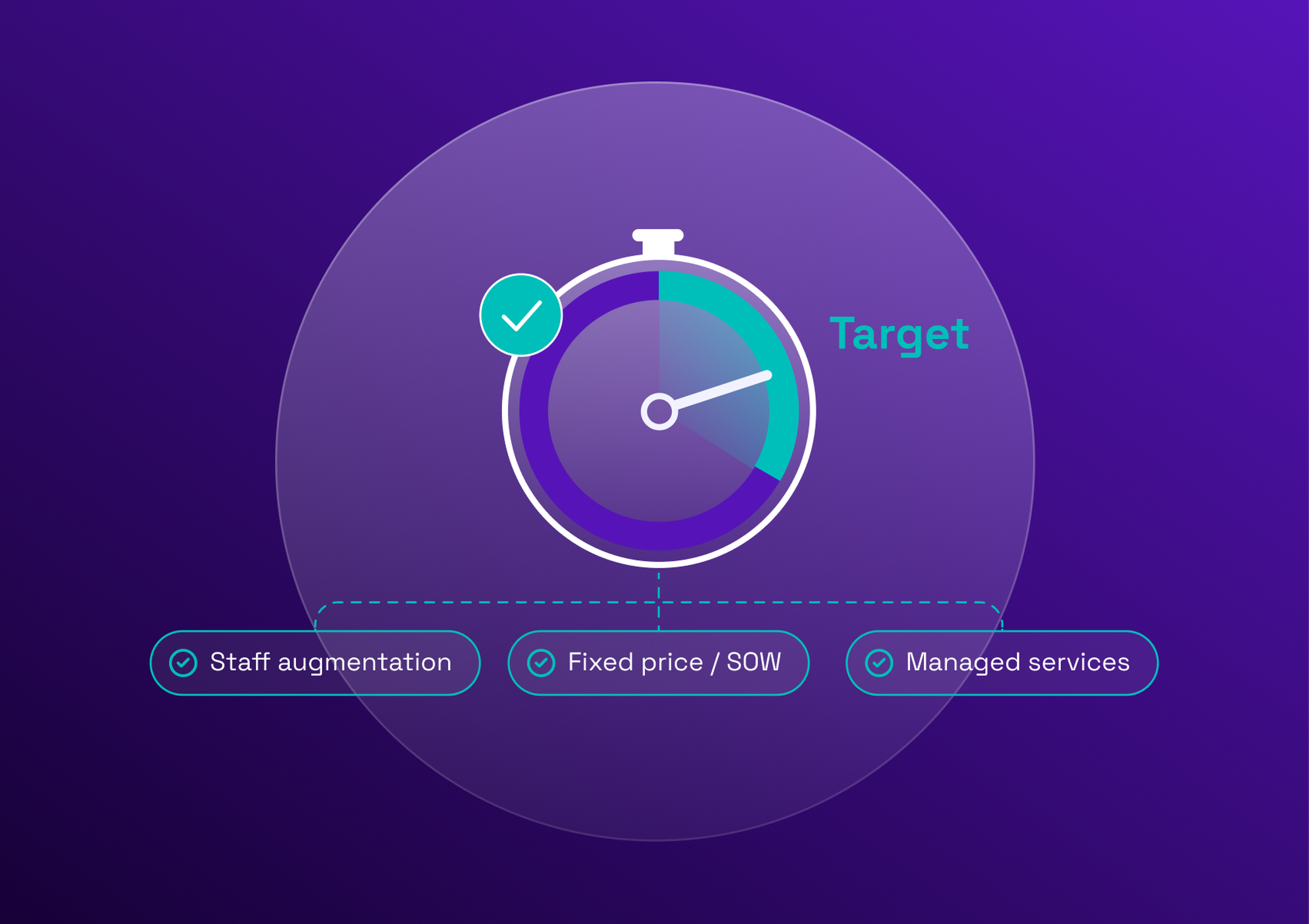
The right metrics depend on how the work is bought. The choice between day rate vs fixed price decides what can be measured, and the choice between staff augmentation vs managed services decides who is accountable for the result. The targets below are illustrative starting points to adapt to your context, not benchmarks.
| Engagement type | Metric | Starting point to adapt | How to measure |
|---|---|---|---|
Time and materials, staff augmentation | Time to submit qualified profiles | 3 profiles within 5 working days of the request | Timestamps from request published to profiles received |
Time and materials, staff augmentation | Time to onboard | Consultant ready to start within 10 working days of the order | From order to the consultant's first day |
Time and materials, staff augmentation | Consultant replacement time | Replacement within 10 working days of notice | From notice to the replacement's first day |
Time and materials, staff augmentation | Timesheet submission on time | 95% submitted by the cut-off date | Share of timesheets submitted before the deadline |
Time and materials, staff augmentation | Unplanned attrition rate | A ceiling agreed per contract | Consultants leaving before the planned end, over the total |
Fixed price, SOW projects | Milestones delivered on time | At least 90% on the agreed date | Milestone dates against actual delivery dates |
Fixed price, SOW projects | Deliverables accepted on first submission | At least 80% accepted without rework | Acceptance records per deliverable |
Fixed price, SOW projects | Budget variance | Within 5% of the planned budget | Invoiced amount against the SOW price |
Fixed price, SOW projects | Defect or rework rate | Under 10% of deliverables sent back | Rework requests over deliverables submitted |
Managed services, IT support | Incident response time | Priority-1 incidents within 30 minutes | Ticket timestamps |
Managed services, IT support | Resolution time | Priority-1 incidents within 4 hours | Ticket timestamps |
Managed services, IT support | Availability | 99.5% during business hours | Monitoring tool |
Managed services, IT support | First-contact resolution | 70% of tickets resolved at first contact | Ticketing system |
Keep each SLA to five to eight metrics, and make sure each one can be measured from data you already collect. A metric nobody can measure becomes a dispute. Alongside the SLA, the wider procurement KPIs show how the supplier panel performs as a whole.
Service level agreement examples
Three mini-examples show how the pieces fit together: the service, the metric, the target, the measurement and the remedy. This kind of SLA example is a starting point, and every figure should be adapted.
Example 1: staff augmentation
| Element | Value |
|---|---|
Service | IT consulting staff augmentation |
Metrics | Time to submit qualified profiles, consultant replacement time |
Target | 3 qualified profiles within 5 working days of the request, and replacement of a departing consultant within 10 working days of notice |
Measurement | Timestamps for the request, the profiles received, the notice and the replacement's first day |
Remedy | A credit of 5% on the monthly fee if either target is missed |
Example 2: fixed-price engineering project
| Element | Value |
|---|---|
Service | A milestone-based engineering project under a SOW |
Metrics | Milestones delivered on time, deliverable acceptance |
Target | Each milestone delivered on its agreed date, and deliverables accepted within 10 days of submission |
Measurement | Dates in the SOW milestone log and the acceptance records |
Remedy | A credit of 2% of the milestone amount per week of delay, capped at 10% |
Example 3: IT managed service
| Element | Value |
|---|---|
Service | Managed IT support |
Metrics | Priority-1 incident response, availability |
Target | Response within 30 minutes, and 99.5% availability during business hours |
Measurement | The ticketing system and the monitoring tool |
Remedy | A service credit on the monthly fee, calculated as shown in the next section |
What happens when an SLA is breached? Penalties, service credits and earn-backs
A service level agreement breach has three possible consequences. A service credit reduces the next invoice, and is a common remedy. A financial penalty is a fixed amount owed for a miss, and whether it can be enforced depends on the governing law. A termination right lets the buyer exit after repeated or serious misses. An earn-back lets the supplier recover a credit by exceeding the target in later periods.
The service level agreement formula for a credit is simple:
Service credit = monthly fee × credit % per point of shortfall × points missed
Worked example: the monthly fee is €40,000, the credit is 2% per point, and the supplier achieves 97% against a 99% target. The shortfall is 2 points, so the credit is €40,000 × 2% × 2 = €1,600. This is how to calculate a credit when the SLA is written in percentage points.
Penalties should be capped, and paired with a corrective-action plan. Without a cap they push the supplier to dispute every miss, and without a plan they punish the miss without fixing its cause, which damages the relationship. SLA penalties work best as a last signal, not as the main tool.
How to monitor SLAs across all your suppliers
The problem is rarely the SLA itself. SLA data sits in spreadsheets, emails and supplier self-reports, and nobody has a single view across dozens of suppliers. What good looks like is the opposite: each SLA is tied to a mission, measured from operational data such as timesheets, deliverable validations and invoices, consolidated in a supplier scorecard, and fed back into panel and renewal decisions.
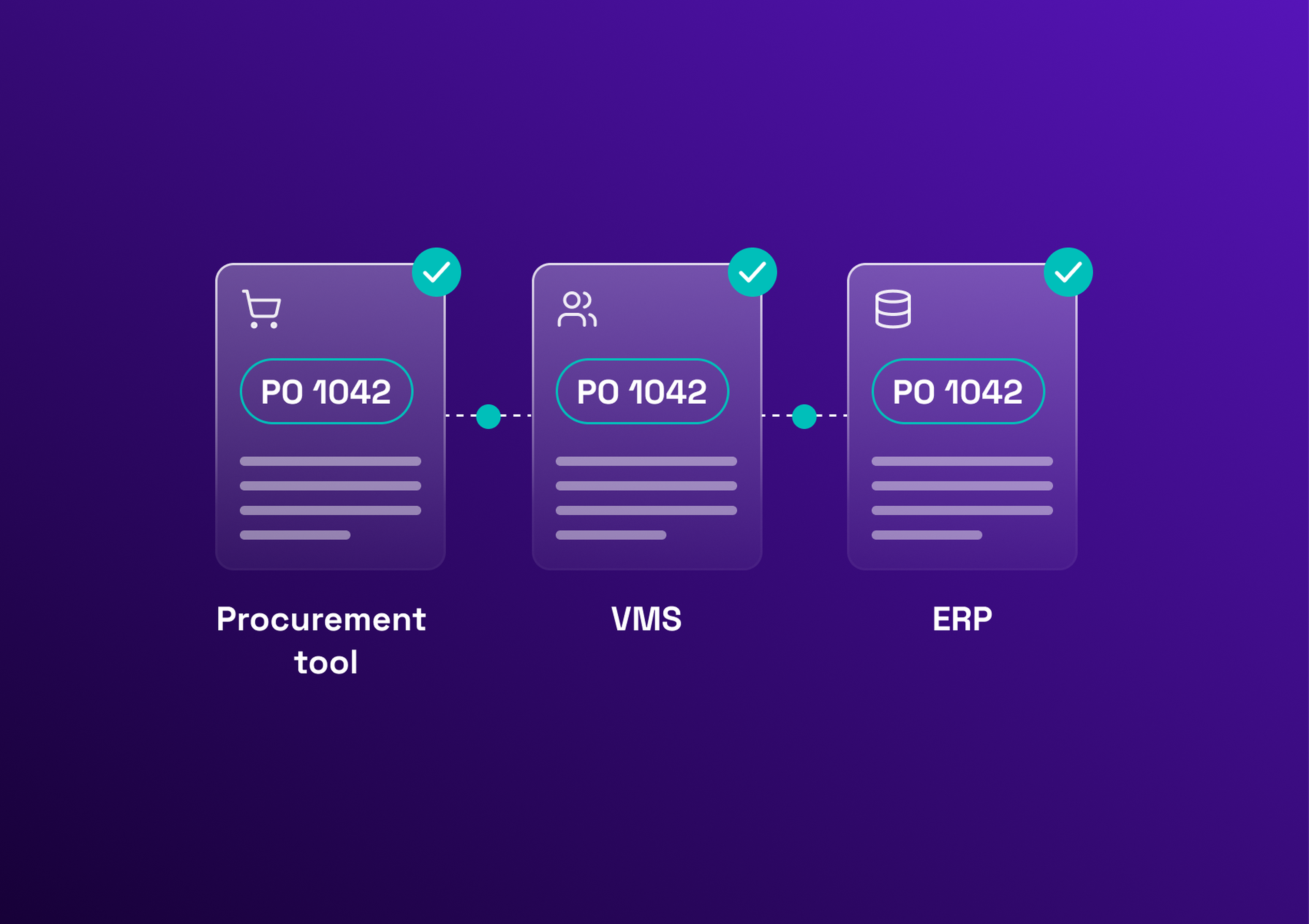
A vendor management system holds that data in one place, since it already carries the missions, the timesheets, the milestone validations and the invoices. Tracking SLA compliance is a standard VMS function, alongside KPIs and dashboards. That makes it possible to follow supplier performance across every mission without rebuilding the figures by hand each quarter. The guide to supplier performance shows which indicators to follow once the data is in one place.
6 common SLA mistakes procurement teams make
Copy-pasting IT uptime SLAs onto consulting contracts, where availability says nothing about the quality of the work.
Too many metrics, so none is followed. Five to eight is enough.
No agreed data source, so every miss becomes a debate about the figures.
Penalties with no cap or no corrective plan, which turns each miss into a dispute.
Never reviewing the SLA after signature, so targets are either too easy or no longer relevant.
SLAs nobody on the business side knows exist, so the people who see the service every day cannot report a miss.
Tracking supplier SLAs in one place
An SLA is only as useful as its measurement. Choose metrics that fit how the work is bought, write the remedies down, and measure from data you already hold. See how Eleven VMS follows supplier performance across every mission, from the request to the approval of time, on the Eleven VMS solution page.
Book a meeting with one of our experts for a personalized demo.